In the spring of 1921, a man shut himself off from the world.
For 39 days, he secluded himself while in a state of mental ecstacy, neither ill nor deranged, but consumed by something he called an “illumination.” When he emerged, he said he had seen behind the veil of the cosmos. The message he received would end up being written down in 10,000 words - without a single erasure. Doctors, who read it said that it “out-witted Walt Whitman.” It would would end up being called The Divine Iliad, and he believed it was not him who authored it, but he and the Creator thinking and working as One.
His name? Walter Russell.
This is his story.
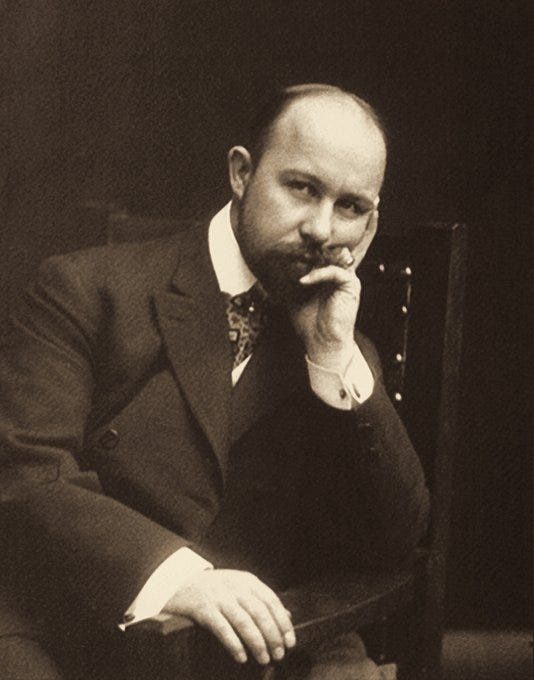
A portrait of Walter Russell
Most people today have never heard of him.
Yet Nikola Tesla once urged him in a letter to:
“lock away your knowledge for a thousand years, until humanity is ready for it.”
Russell didn’t listen of course…
Instead, he spent the rest of his life teaching, sculpting, writing, and trying to awaken the world to the true cosmology of the universe: not a cold, mechanical universe - but a dynamic, electric, thought-wave universe - controlled by Mind.
But Walter Russell was no fringe prophet scribbling visions in obscurity. He was a celebrated sculptor, painter to presidents and their children including Teddy Roosevelt, was a friend of Mark Twain and Thomas Edison. And somewhere along that gilded path, he became something more: a philosopher-scientist
So who was he? And why did history try so hard to forget him?
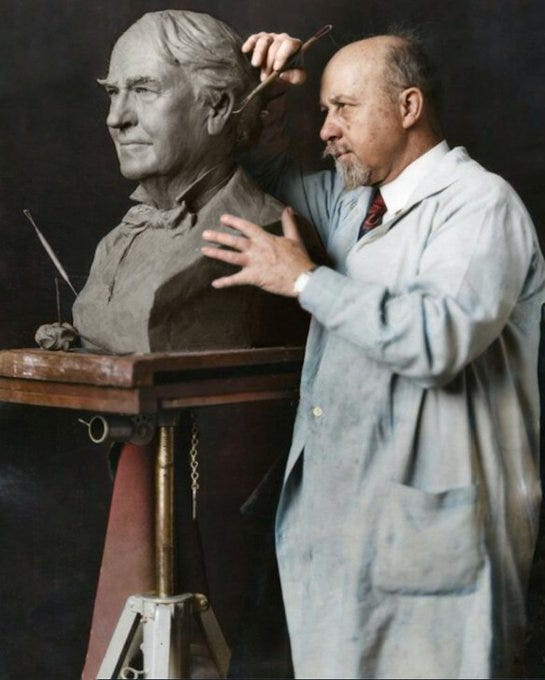
Walter Russell sculpting the official bust of Thomas Edison which was his first ever attempt in the medium
From Piano to Presidents
Walter Russell was born on May 19, 1871, in Boston, Massachusetts.
His story begins not with science or mysticism - but with music.
Before he could walk, he was learning to play piano from a blind neighbor named Mr. Maynard. He showed an early talent for absorbing knowledge through intuition rather than instruction - a principle he would demonstrate and teach his entire life.
By age seven, he had his first mystical experience. He later described it as entering a state of "Cosmic Consciousness" - a recurring event that would happen every year around his birthday, intensifying every seventh year.
“Then it happened - a blinding glare - red - then incandescent - then a field of blue shut the whole world of all things out from me, leaving nothing but indescribablye ecstacy, while my body wandered by itself without me to the great root of my beloved oak…” Walter Russell, Home Study Course
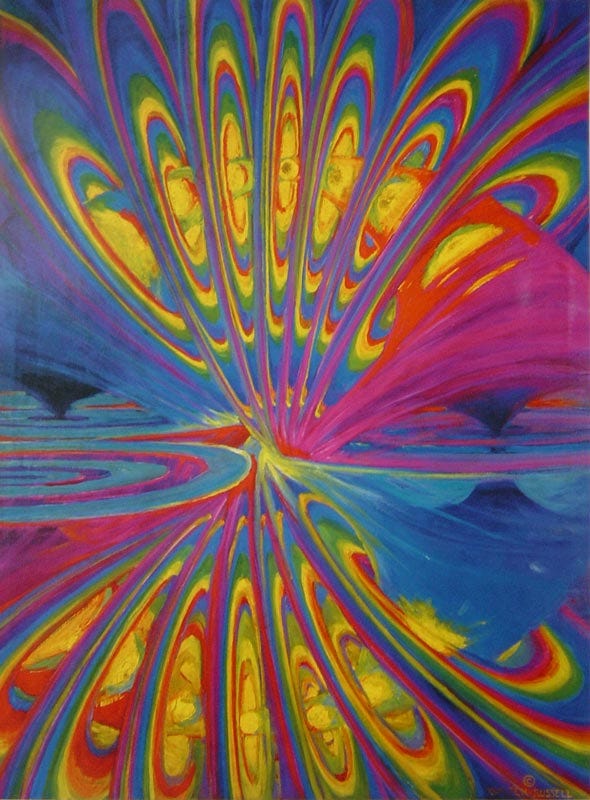
“The Octave Wave” by Walter Russell - A glimpse ‘Beyond the Cosmic Veil’ of the material universe
At age nine, he was forced to leave school and work to support his family. Formal education ended abruptly. So he educated himself.
By his late teens, he was studying art at the Massachusetts Normal Art School and painted obsessively, studied anatomy and learned architecture.
His hard work would pay dividends.
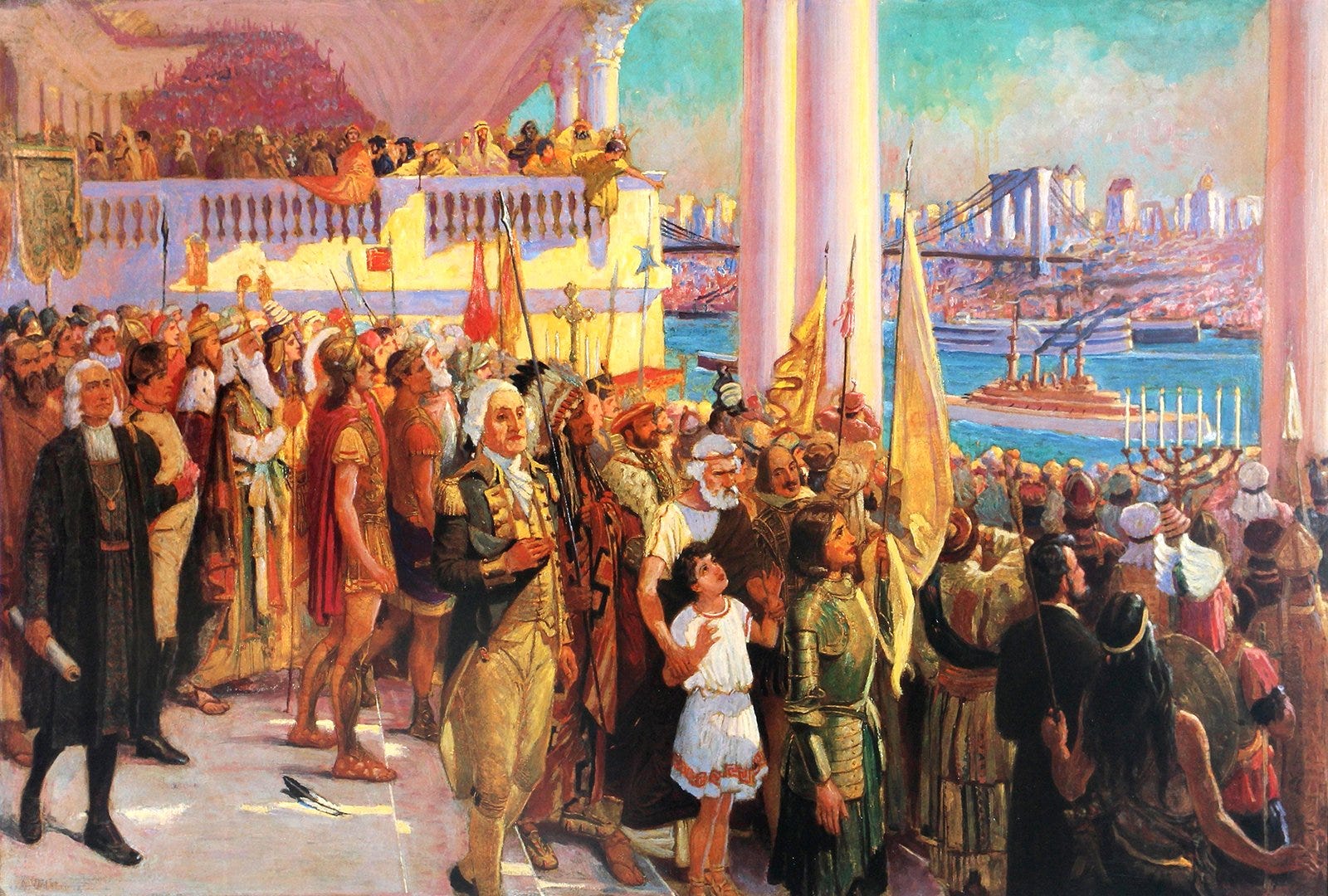
He gained fame as a painter early, winning international acclaim for his piece The Might of Ages and painted the children of President Teddy Roosevelt. He built Manhattan’s famous Hotel des Artistes and would serve as the official sculptor to President Franklin D. Roosevelt.
He, by all measures, had made it.
But something big was about to happen…
The Might of Ages by Walter Russell
The Illumining
Then came May of 1921.
Approaching his 49th (his seven times seventh birthday), Russell withdrew from public life and entered what he called “a state of divine illumination.” For 39 days, he experienced the sensation of his Mind being disconnected from his body - so intensely, he later said he had merged with Mind. (Walter used Mind and God interchangeably).
During that time, he said that he saw the auras of people going up and down in elevators, and heard, with inner ears, the creaks and groans of Earth correcting itself in its rotation and orbit. He would later say that the Music of the Spheres, as coined by Pythagoras, wasn’t an abstract concept, but a reality.
He saw the true architecture of the universe - and realized that science had gotten it all wrong.
Central to his vision was the First Principle which God told him to name:
Rhythmic Balanced Interchange
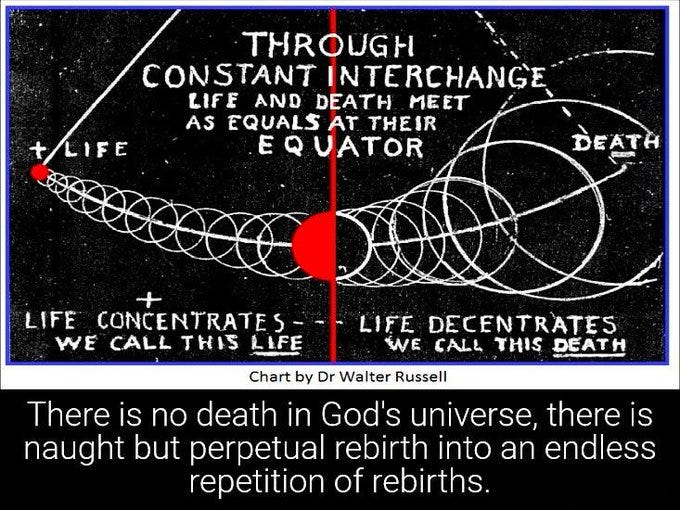
To Russell, this was the cosmic law behind all creation (and one which I will go into much more detail in future articles.) Energy wasn’t in matter - matter merely expressed energy - in perfect symmetry, between polar opposites: light and dark, hot and cold, male and female, positive and negative, life and death, compression and expansion, love and hate and all other opposite terms. The universe wasn’t a soulless machine. It was the expression of the principle of life itself, pulsing in balanced rhythmic cycles.
He emerged with a new mission: to share what he had seen so that humanity might unite, instead of destroying itself from its ignorance of the law.
Thus began his second life.
The Science of Light and the Soul
Russell published The Universal One in 1926 - a dense, intricate work of physics, chemistry, and spiritual insight. It was not received well by the scientific establishment who lashed out at the artist for stepping into their territory.
But it wasn’t entirely ignored...
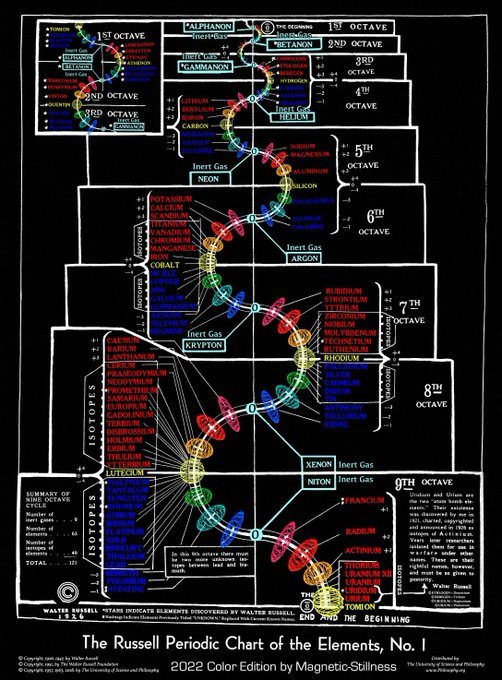
He proposed an “octave” structure of matter, in which chemical elements were arranged in harmonic octaves - a direct challenge to the standard periodic table. \
In a lecture to prominent chemists of his day he said that:
…you should just throw it out, (the Mendeleev Periodic Chart) because you are eventually going to have to anyway…”
His 9-octave chart of the elements, centered on carbon, the only perfect cube and sphere produced in nature, and predicted the existence of five elements then unknown to science.
Two of them - Neptunium and Protactinium (Named Urium and Uridium by Russell) - were eventually isolated in a lab by two scientists who attended one of his lectures.
One of the attendees, Edwin McMillan, who was later credited with the discovery of Neptunium, went on to win the Nobel Peace Prize for it.
Russell was never credited.
He was however awarded a doctorate by the American Academy of Sciences in 1941 for the prediction of those 5 elements - Deuterium, Tritium, Neptunium, Protactinium and Plutonium.
But of course that wouldn’t slow down Russell.
While releasing parts of The Divine Iliad to the world, he would go on to publish The Secret of Light (1947), a book that unified the spiritual and scientific worlds under a single law: All matter is but motion and is a simulation of God’s still white light of Love.
However, he was worried. After the book’s release the Cold War began to ramp up. If humanity didn’t grasp these principles soon, he feared, civilization would collapse under its own disunity, and would possibly end in nuclear winter.
It wasn’t a conventional school. There were no degrees, no credentials, no academic hierarchy.
What it offered was far more radical: a place where science, art, and God could converge, multiply, and bear fruit for the betterment and uplift of mankind.
Together, Walter and Lao taught the principles of Universal Law and the inherent genius and divinity locked up in every man and woman - not as religious doctrine, but as scientific fact.
Russell didn’t believe in genius as a genetic lottery. He believed genius was self-bestowed.
His motto: “Mediocrity is self-inflicted; genius is self-bestowed.”
That Truth - was at the heart of his entire project. If each human being is a microcosm of divine order, then each of us has the capacity to create, to understand and elevate everyone around us.
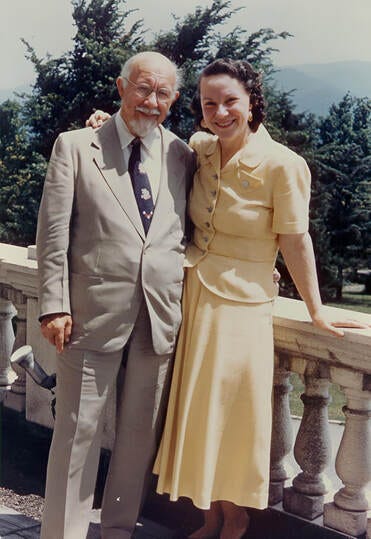
Walter and Lao Russell at their home in Swannanoa, Virginia
Unfortunately, Russell’s work was too ahead of its time for the scientists of his day.
Too mystical for scientists.
Too practical for theologians.
Today, the scientific world largely ignores him. His predictions about atomic structure were never formally tested. His theories of light and matter remain outside academic discourse.
And yet, cracks have begun to form in the materialist worldview…
Quantum physics has forced us to consider the role of consciousness in the universe. Neuroscience still thinks the consciousness is located in the brain instead of being omnipresent.
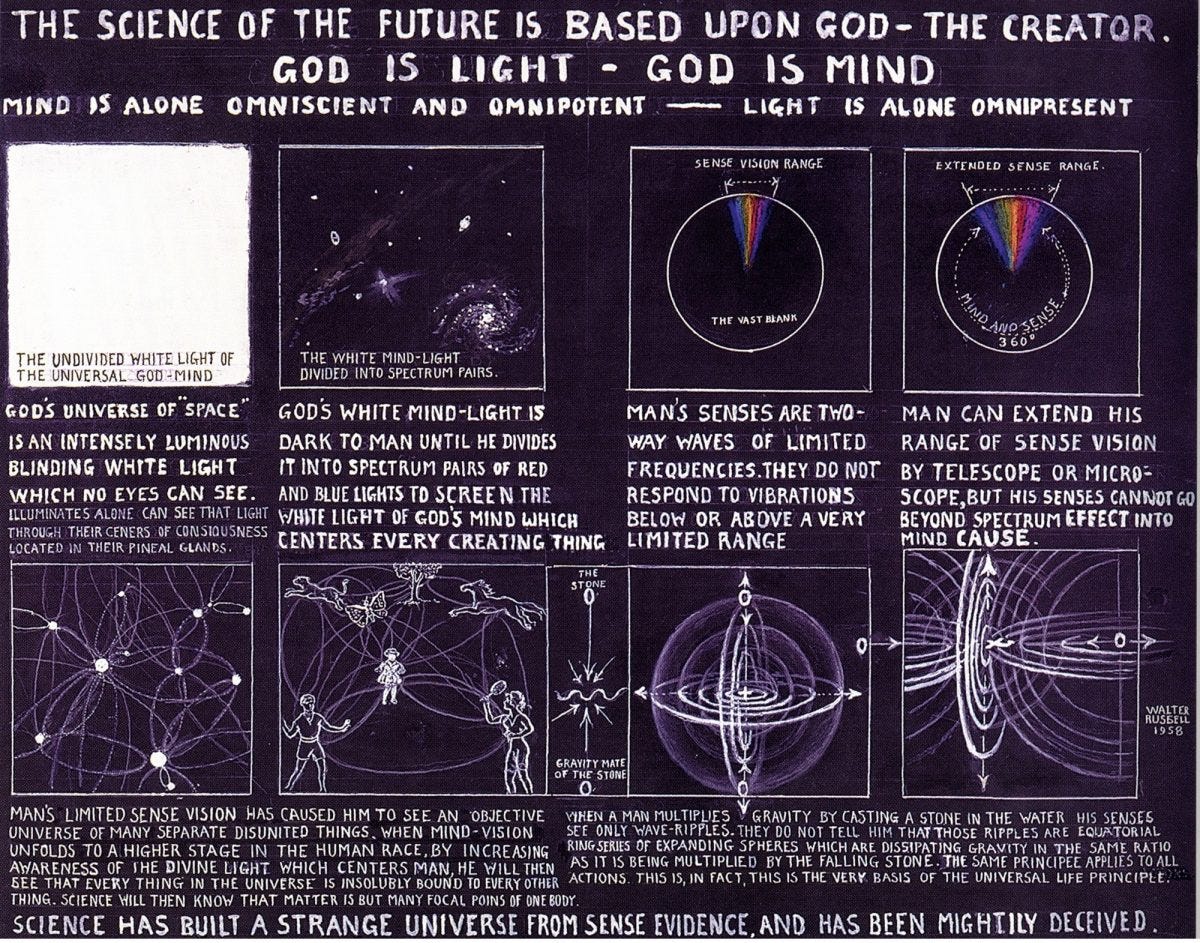
One of Walter Russell’s Charts
Walter Russell died on May 19, 1963—his 92nd birthday.
I highly recommend his is biography, The Man Who Tapped The Secrets of the Universe.
His vision of reality - as rhythmic, conscious, and deeply unified - now echoes in movements exploring everything from the holographic universe to the simulation hypothesis.
This Substack is reader-supported. To receive new posts and support my work, consider becoming a free or paid subscriber.
With gratitude, M.R. Post Creator, Beyond the Cosmic Veil
You will really enjoy the HSC. I have been a student and practitioner--to the best of my ability-- for 15 years. The biggest obstacle to his work for most people are Russell's definitions of words and how he edits them.


You will really enjoy the HSC. I have been a student and practitioner--to the best of my ability-- for 15 years. The biggest obstacle to his work for most people are Russell's definitions of words and how he edits them.
These are the stories that we need to hear more of!