
The Most Important Art Book You've Never Heard Of
Why Modern Art Got Beauty Completely Wrong

We have been taught, with remarkable consistency across schools and universities and galleries, that art is fundamentally subjective and that beauty lives in the eye of the beholder, that there are no rules, no standards, no objective foundation beneath our aesthetic experience.
Anything can be art, and anything can be beautiful, and to suggest otherwise is to invite accusations of elitism or cultural imperialism or some other -ism.
This idea has been institutionalized so thoroughly that it has permeated ever facet of our culture, from painting, to music, to architecture and everything in between. Yet something quite ironic has happened as a result.
We have more art than ever before, and less beauty. More expression, and less meaning. More freedom, and less mastery.
This is not a coincidence, and it is not the result of some cultural accident. It is the direct consequence of a single foundational assumption that Beauty is something we invented, rather than being a Universal Principle.
In other words, it comes from the materialistic assumption that the quality of Beauty is found in paint pigments, chiseled marble and the sounds of the symphony instead of a universal quality which is extended to a product from the Mind of its creator.
Nowhere is that reconsideration made more available, or more explicit, than in one of the most overlooked texts in the history of aesthetics: The Tibetan Book of Proportions.
What is immediately striking about The Tibetan Book of Proportions is where it chooses to begin. It doesn’t begin with expression, with feelings, or with the inner life and struggles of the artist.
It begins and ends with proportion.
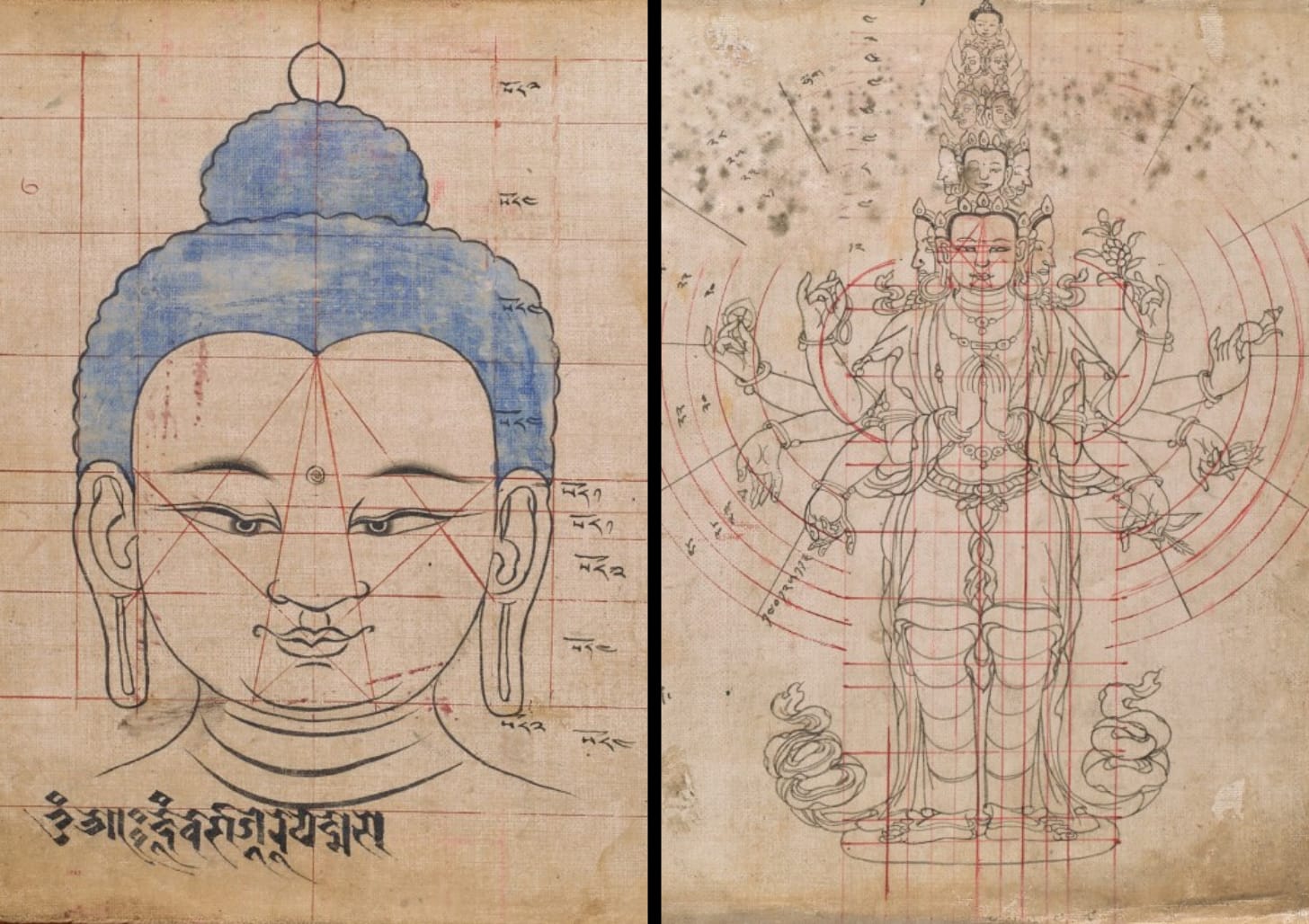
The foundational question is not “What do you feel?” but “What is the relationship?” Every figure, form, and gesture is governed by proportion, and not arbitrary or personal preference but a universal proportion.
The proportional relationships used to construct sacred figures in the Tibetan Buddhist tradition are not inventions. They are not even unique to Tibet, these universal proportions were used across the ancient world all the way back to the construction of the Egyptian pyramids and were rediscovered en-masse in the West during the Italian Renaissance.
These universal proportions are the same proportional relationships found in the architecture of the human body, in the patterns of natural growth, in the harmonic intervals that make music rhythmic and coherent.
That last parallel—music—is the one worth dwelling on.
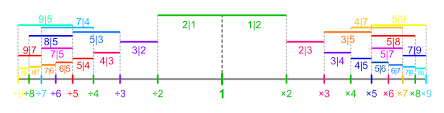
The interval-ratios that create harmonic-balance in music are not matters of taste. An octave is not a feeling; a perfect fifth is not an opinion; the diatonic scale is not an expression of personal preference.
These are mathematical and geometrical relationships standing in exact proportional relation to one another. The physics of sound does not care about the listener’s subjective experience. It operates according to law, the Law of Balance. And the Tibetan system of proportion operates on precisely the same foundations, applying to visual form what music theory applies to sound.
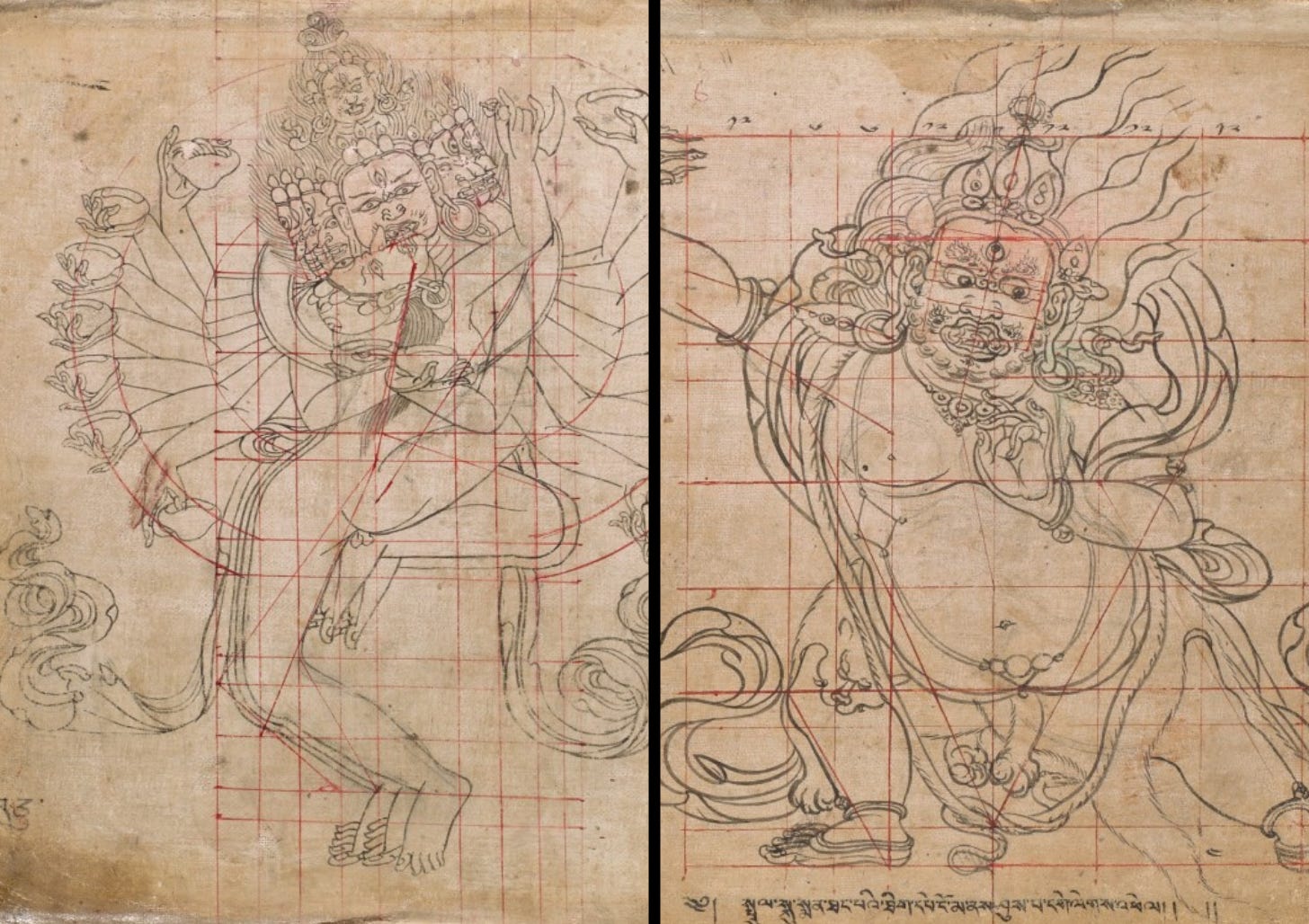
This is the insight that modern art has systematically abandoned. When art divorces itself from Balance, it divorces itself from the underlying foundation of reality and falls into an unholy matrimony of mediocrity. The chaos that characterizes so much contemporary work is not profound; it’s as vacant and void of meaning as the thoughts of its creator because it has severed its connection to the eternal universal principles that gives form its meaning.
The only reason these morose meaningless monstrosities are brought to social prominence is because those that are attracted to them reflect their qualities.
Like attracts like.
BEAUTY
Beauty is not subjective, nor is it a characteristic of matter. It is our Mind’s awareness of the recognition of the quality of Universal Balance, expressed in relationships, by proportion. Beauty is a Soul-quality; it’s a Mind-quality. The art of anything isn’t in the skill of the rendering of a visible or audible thing, it’s in the Mind-qualities of Beauty and Love which only the stillness of the Light of your Soul can extend to it.
Your ability to extend Beauty and Love into material bodies, constructed in the image of your spiritual conceptions, is the measure of your ability to create masterpieces.
Beauty isn’t in technique or the created product, it is in the Mind-Soul of its creator.
To understand drawing through the lens of the Tibetan Book of Proportions and the masters of the Renaissance is to arrive at a completely different definition of what is taught in our institutions.
Drawing, in this framework, is not just a skill in the conventional sense and not just a set of techniques for rendering objects convincingly.
Drawing, and the arts as a whole, are disciplines for the training of our thoughts and actions to imitate God’s thoughts and creative actions as expressed in Nature for the purpose of transferring an IDEA from the intelligence of one mind to the intelligence of another—all art is a thought transference.
All of nature, from its most minute particle to its most mighty galaxy are composed of light waves. Light waves are divided into octave symmetries in the same proportions as our musical octaves—which are the same symmetries that divide white light into its spectrum colors which the painter wields to tell immortal stories.
When you create using balance and proportion as your guide, you are training yourself to see, and are learning to perceive things not as isolated objects but relationships of a whole.
Balance and proportion are epistemic tools for revealing Beauty, Knowledge and Truth. They are bridges between what is materially seen and what is spiritually KNOWN.
Art is not, strictly speaking, for creating pretty things; it is a mental (spiritual) practice. The greatest beneficiary of art is the artist.
Michelangelo, who understood this intuitively if not in these explicit terms, said that, “Art lives on constraint and dies of freedom.” It is a statement that sounds paradoxical until you understand what constraint actually means in the context that was laid out above.
Constraint is not limitation in the sense of restriction or deprivation; it is structure, the condition that allows anything to exist meaningfully at all. When you remove constraint, you remove relationship. When you remove relationship, you remove coherence. And when you remove coherence, what you have is no longer art in any substantive sense — it is randomness wearing art’s clothing.
The Tibetan system preserves constraint, and in doing so preserves Beauty. To draw within these proportions is to align yourself with REALITY—the eternally still qualities of Mind at REST.
That alignment produces something that transcends technical accomplishment. Art becomes a form of meditation in the most precise sense—a process of unfolding Mind-awareness, moving from distortion toward clarity, and of dissolving the illusion of chaos in the Reality of Unity.
Art, understood in this way, is not a hobby, and it is not something children do before they develop more serious interests. It is one of the most direct paths available to us for understanding how the spiritual Reality is structured materially.
To learn proportion is to learn how to see; to learn how to see is to learn how to recognize Love; and recognizing Love is the first step toward being Love by aligning one’s desires, thoughts and actions with it, which is as close to a definition of meaningful creative work as I know how to articulate.
The Tibetan Book of Proportions is not, at its core, teaching you how to construct iconographically correct figures. It is teaching you how to know Balance by being balanced, and once your Consciousness becomes aware of it, you cannot stop. You start to recognize it in music and in architecture, in natural forms and in human faces, and you also start to recognize, with equal clarity—when it is absent.
That negative capability—the ability to feel the absence of Balance as a kind of wrongness—is itself a form of knowledge that most people never develop, because they have been told since childhood that such judgments are merely personal preferences. For one of the things we were repeatedly force fed growing up was the mantra: don’t judge.
This is where the concept of co-creation begins to enter the consciousness of man-in-the-mass. When you create using Universal Principles as your structural foundation, you are not guessing. You are working as one with the Eternal Universal Mind that simulates our material-reality, and in doing so you step into a fundamentally different meaning of the creative act and whatever your concept of what God is.
You are not creating Love, Beauty, or Truth; you are unfolding those eternally existent qualities from within you. The artist, in this framework, is not an originator of Idea but an interpreter in something far larger than mere individual expression.
Most people will go on believing that art is subjective, that anything goes, that rules are for people who lack imagination. But that belief carries a cost that is rarely acknowledged: without structure, there is no mastery; without mastery, there is no depth; and without depth, there is no meaning- and without meaning we won’t remember it.
Do you remember the name of the modern performance ‘artist’ that stacked buckets of sand, and punctured holes in them until they toppled under their own weight?
I didn’t think so.
But you do remember Michelangelo, Leonardo, Beethoven and Shakespeare.
The Tibetan Book of Proportions offers an alternative to this impoverishment, not by promising freedom in the modern sense, but by offering something older and more valuable: constraint. And in that constraint, paradoxically, a genuine freedom emerges—not the freedom of doing anything, but the freedom that comes from working with Universal Law.
Friends, if you enjoyed this and got something out of it, please comment below, share, and consider upgrading to a paid subscription to help support my work. All paid subscribers receive a complimentary copy of my book The Art of Persuasion: 20 Rhetorical Tools for Writers (a $9 value) and private access to all my YouTube videos before they go public.