
Modern Education is Broken
And there is only one way to fix it...

For the past sixteen years, I have been teaching English within the Japanese public school system, from kindergarten to high school.

During that time, I have had a front-row seat to how modern education operates, not only in theory, but in practice, day after day, across thousands of students.
And what has become increasingly clear to me is this:
Modern education does not teach students how to think.
It teaches them how to remember and repeat.
This is not a criticism of teachers. Most are doing the best they can within the system they have been given. It is a criticism of the structure itself, because the structure determines the outcome.
When you step into a classroom today, what you see is painfully consistent.
Information is delivered, students are expected to memorize it, and then reproduce it under pressure. Once the test is over the information is immediately forgotten and is replaced by the next set of disconnected information.
The deeper issue is not the memorization itself, because having the ability to memorize is valuable.
It is the compartmentalization of knowledge.
Every subject is isolated from every other subject. Mathematics is taught as if it has nothing to do with music. Language is treated as something entirely separate from math and music. The arts are often ignored and are treated as ‘activities that kids do’ rather than a foundational practice of what makes us human.
As a result, students never learn to see what actually matters.
They do not learn to perceive the underlying principles, patterns and axioms that connect all knowledge.
And without that, there is no real understanding—only repeating.
Automatons repeat and cannot create.
The Fix
At one point in history, education was organized around a very different idea—The Trivium and Quadrivium.
The Trivium was comprised of grammar, logic and rhetoric.
The Quadrivium was comprised of geometry, arithmetic, music and astronomy.
* Let it be noted that I group all mathematics together—arithmetic, algebra, calculus, trigonometry, etc.—and use the term mathematics as a general term.
The Trivium and Quadrivium were not simply a random collection of subjects. They were a coherent system designed to train the mind to recognize patterns, to think clearly, and to express that thinking logically and precisely.
What makes this system powerful is the way the different subjects echo one another.
Each discipline reinforces the others.
Each reveals the same principles from different angles.
Modern education has lost that sense of unity.
Music once tied everything together.
Music is neglected in modern education, but music theory should be taken just as seriously as mathematics—because it is mathematics in space and time.
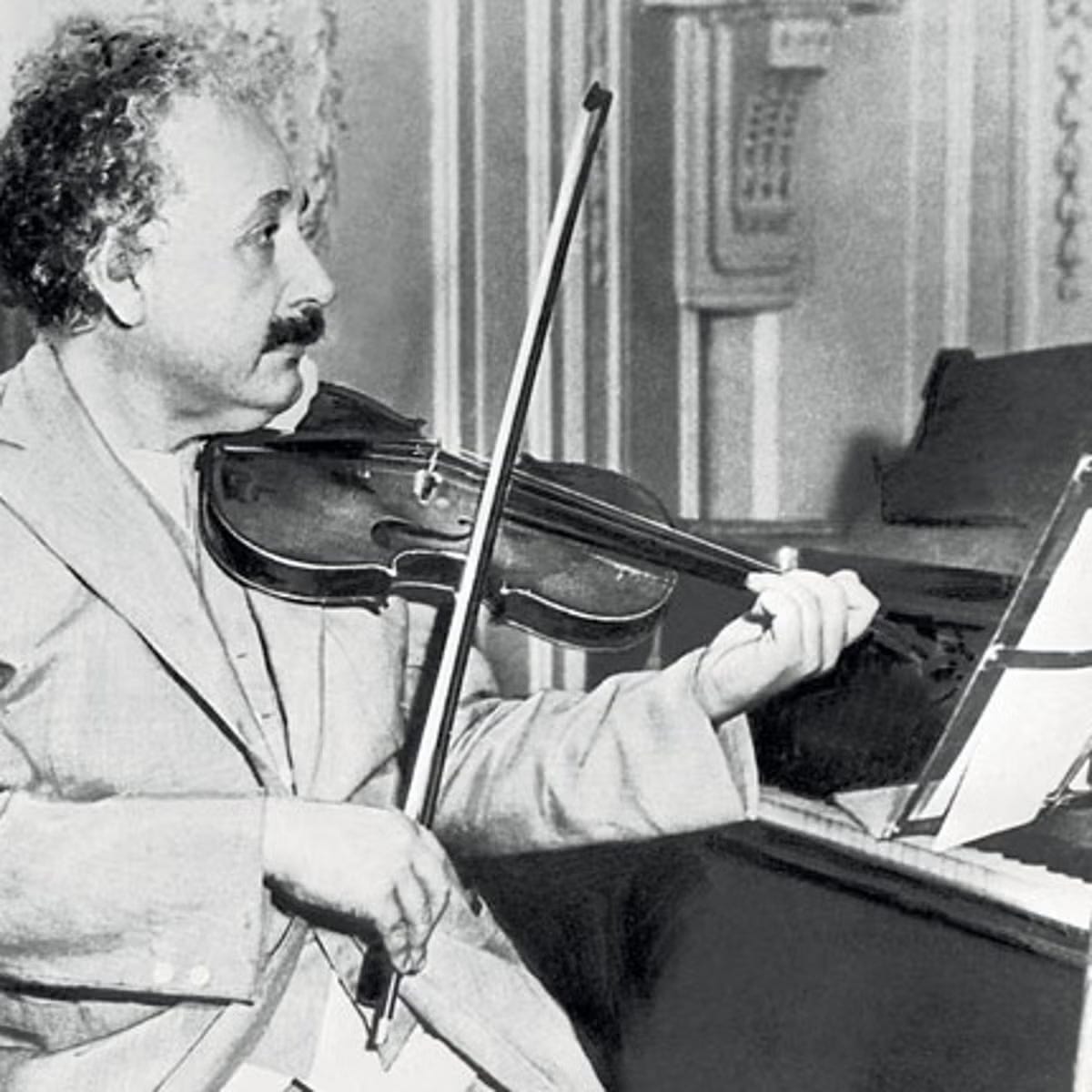
"I often think in music. I live my daydreams in music….music and physics are just different ways to understand the world.”
-Albert Einstein
Poetry is mathematics and music applied to language.
The same mathematical ratios that create harmony in music and poetry were intentionally used by architects to construct buildings that have endured for centuries.
It is the same principles expressing themselves over and over again through different mediums.
If we are serious about restoring education, we do not need to invent something new. We need to recover what worked — and refine it.
One of the most important corrections we can make is to reunite mathematics and geometry.
These are not separate disciplines. They are two expressions of the same thing. In ancient times, geometry and math were inseparable—geometry was math.
Mathematics is difficult to visualize, but geometry is mathematics expressed in form.
When these are taught separately, students struggle. When they are taught together, understanding becomes intuitive. The student no longer memorizes formulas—they begin to see relationships.
A New Pillar For The Quadrivium
After arithmetic, mathematics and geometry are combined it leaves the Quadrivium with only three subjects.
There is another subject which must take the place of the fourth pillar.
Academic drawing.
We all know drawing is the foundation of painting, sculpture and architecture.
But how does drawing help in mathematics, you ask?
When studying trigonometry in school, for example, did you ever get frustrated because you couldn’t visualize what you were doing?
Remember sine, cosine and tangent and the seemingly meaningless parabolas (those curved lines) your scientific calculators spat back at you? Those parabolas were describing ellipses.
What IS trigonometry?
Trigonometry is the study of how angles generate proportion, motion, and form— beginning with triangles, extending through circles, and ultimately describing curved geometries such as the ellipses of spheres and cones.
When a student learns how to constructively draw a sphere or a cone and section it, they are no longer dealing with abstract concepts. They are constructing a visualization of the abstract concepts they are studying and de-mystifying it.
Drawing trains the mind and the eye to see structure.
And once a student can see structure, they can begin to understand it.
Academic drawing is the shore where the abstract meets the concrete.
Here are some of my personal geometric constructive drawings I did while studying academic drawing.
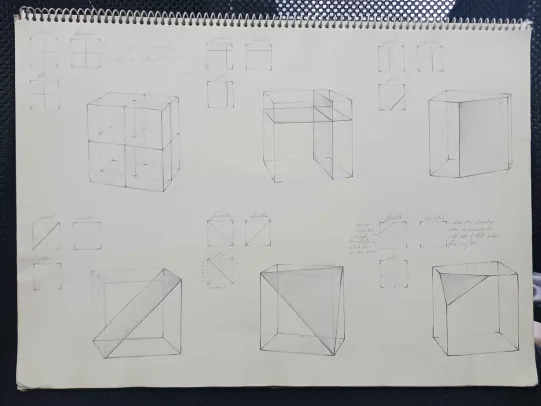
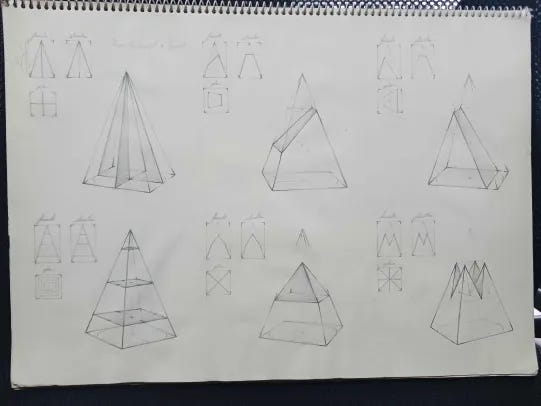
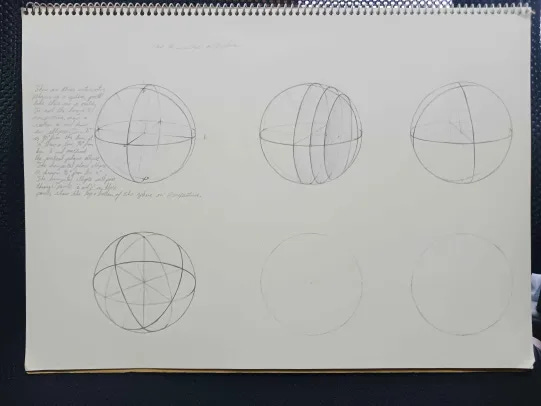
Through academic drawing, the abstract concepts within mathematics stop being confusing symbols on a page and become observable realities.
This ties into one of the other pillars of the Quadrivium—astronomy.
How?
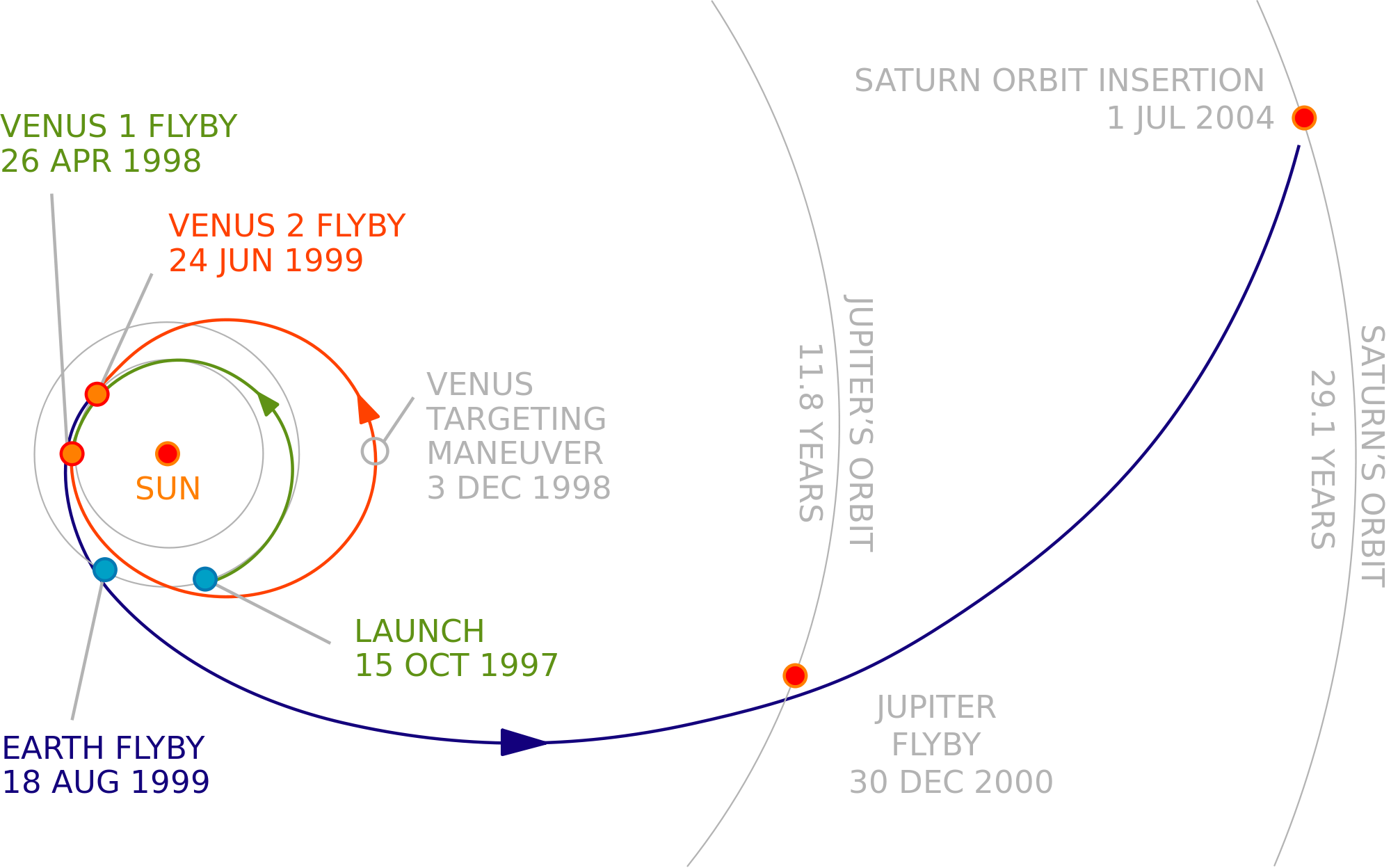
Planetary orbits are calculated using trigonometry because all planetary orbits are elliptical.
Additionally, trigonometry is one of the tools we use the calculate satellite trajectories.
What modern education lacks is not information.
We have more information available than at any point in history.
What it lacks is unity.
We need to return to a system where subjects are not taught in isolation, but as parts of a unified whole.
We need to teach students how to see the unifying principles which weave their golden threads through every subject.
We need children to see the world as a unified whole again instead of hyper focusing on its individual parts.
Modern education monumentally fails at this.
If we continue on the current path, we will produce students who can memorize and repeat many things but understand very little, who can pass tests but cannot use that knowledge to create anything.
If we restore these principles, we will begin to produce something else entirely.
Genius.
Thank you for reading.
If this resonates with you and you believe education should be about understanding rather than memorization—then I invite you to be part of what I am building.
Share this with someone who cares about their children’s education.
Yes to much of this. I didn’t study the history/concept of the Trivium/Quadrivium until I took classical history in university. But I also think the walls, the physical walls and environments we place children in need to be rethought. I’m intensely jealous of teachers working in ‘forest school’ settings in places like Northern Europe and Finland. We have some ‘forest schools’ in the US but they are largely designed to only serve pre-school ages. Then the kids get sent to regular school settings which must be a real shock to them. The emphasis on having kids sit and try to “focus” at a desk for 6+ hours a day is pretty hard on them to say the least. In the end, I worry that it ends up alienating them from learning rather than enjoying and wanting to learn.
I would like to restack this. Yet considering the topic, I hope I can convince you to do a proof-read and avail yourself of the substack edit feature. The content is important enough to warrant it.